Home / Guides / What to do when someone dies
After a loss
What to do when someone dies: a calm checklist for the first two weeks
When someone you love dies, grief and paperwork arrive on the same morning. That is the cruel part nobody prepares you for. This is a calm, ordered walk through what actually has to happen first, what can wait, and how to keep your footing while you do it.

The short version: In the first day, get a legal pronouncement of death, tell close family, and make sure the home, the pets, and any dependents are safe. In the first week, order about ten certified death certificates, find the will and any funeral wishes, and arrange the burial or cremation. Over two weeks, notify Social Security, the employer, banks, and insurers. Almost everything else can wait, and it should.
If you are reading this with a phone in one hand and a stack of mail in the other, take a breath first. You do not have to do all of this today. Funeral homes, banks, and government offices deal with death every day; they will walk you through their part. Your job is not to know everything. It is to take the next right step, then the one after that.
The first 24 hours: only three things matter
In the first day, ignore the long list in your head. There are really only three things that cannot wait.
1. Get the death legally pronounced. Nothing official can start without it, not the death certificate, not the funeral, not a single account. If your person was in hospice or a hospital, the staff do this for you. If they died at home and it was expected, call the hospice line. If it was sudden or unexpected, call 911 and let the responders take it from there.
2. Tell the few people who need to hear it from you. Not everyone, just the inner circle. Ask one or two of them to help you reach the rest. This is the moment to lean on people, not to be strong alone.
3. Secure what they left behind. Lock the house. Bring in the mail so it does not pile up and signal an empty home. Make sure pets are fed and any dependents are cared for. If there are medications or valuables in the house, note where they are. That is enough for one day.
You do not need to find the will tonight. You do not need to call the bank tonight. The world can wait until morning.
The first week: the death certificate runs everything
Once the funeral home or cremation provider is involved, they will help you register the death and order certified copies of the death certificate. This single document is the key that unlocks everything else, and almost every institution will demand an original, not a photocopy you ran off at the library.
Order more than you think you need. Most families end up needing around ten. A bank, an insurer, the county for the property title, an employer, a pension fund, the motor vehicle office, each one may keep a copy. Ordering ten at once costs a few dollars per copy and saves you weeks of going back. The exact fee and process vary by state; USA.gov has a plain-English guide to requesting them.
This is also the week you arrange the funeral or cremation. Before you sign anything, know your rights. Under the federal Funeral Rule, a funeral home must give you an itemized price list, must let you buy only the items you want, and cannot force you into a package. You are allowed to bring your own casket or urn. Grief makes it easy to say yes to everything; an itemized list, read slowly, protects you.
And this is where it gets quietly hard. To plan a funeral, you have to know what they wanted. Burial or cremation? A service or something small? A specific plot already paid for, or nothing arranged at all? If your person wrote it down somewhere, you are lucky. If they did not, you are guessing about the most personal decision of their life, on one of the worst weeks of yours.
Spare your own family this guesswork
The Final File is a one-time, fill-in planner that records exactly this: the wishes, the documents, the accounts, and where to find it all. So the people you love are never left guessing.
Get the planner $29Weeks one and two: who to notify, in order
With death certificates in hand, the notifications begin. The order below puts the time-sensitive ones first.
| Who | Why it matters | When |
|---|---|---|
| Social Security (SSA) | Stops benefits and prevents an overpayment you would have to repay later. The funeral home often reports the death, but confirm it. | First two weeks |
| Employer or pension | Final pay, life insurance through work, and any survivor benefits start here. | First two weeks |
| Life insurance company | You file a claim with a certified death certificate and the policy number. This is often the money the family actually needs soonest. | First two to four weeks |
| Banks and credit unions | To stop fraud and begin transferring accounts. Do not assume a joint account is automatic; ask. | First few weeks |
| Credit bureaus | Reporting the death to one of the three bureaus helps prevent identity theft, which is sadly common after a death. | First month |
General guidance drawn from the Social Security Administration, USA.gov, and AARP. Programs and timelines vary; confirm with each organization.
The hunt no one warns you about
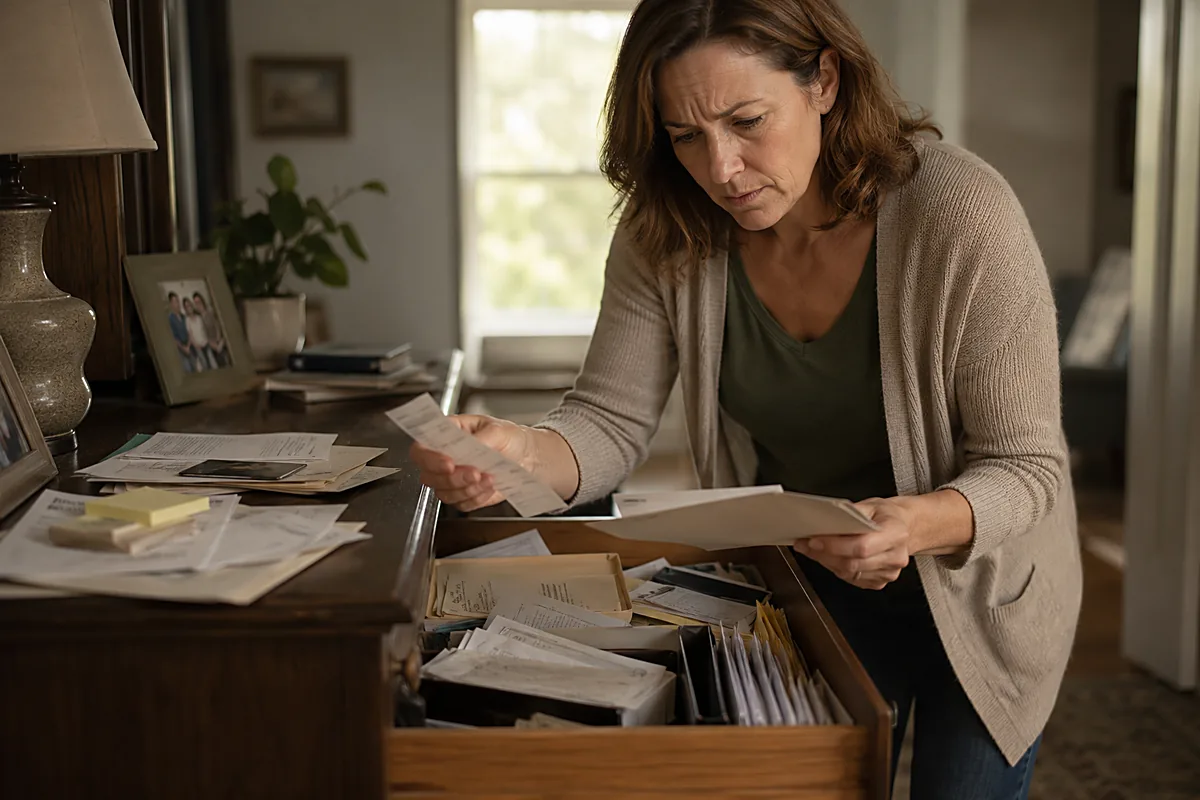
Here is the part that surprises almost everyone. The official steps above are knowable. There are forms, phone numbers, offices with people whose job is to help. The thing that actually breaks people in those two weeks is not the bureaucracy. It is the searching.
It is the phone you cannot unlock, with the photos and the two-factor codes and the texts from the last good day locked inside. It is the life insurance policy you are sure exists but cannot find. It is the bill that keeps charging a card for a subscription nobody can name. It is the will that is "somewhere in the house," or maybe with a lawyer, but which lawyer? It is the friend you know they would have wanted at the service, whose last name you never learned.
Each of these is small on its own. Together, in a grieving fog, they turn two weeks of mourning into two weeks of detective work. And none of it had to be that way. Every one of those answers existed; they just lived only in one person's head, and that person is gone.
What you can safely ignore for now
Grief has a way of making everything feel urgent. Most of it is not. You can put all of the following down for weeks or months without any harm:
- Closing social media accounts and email
- Cancelling streaming, magazines, and small subscriptions
- Sorting clothes, furniture, and belongings
- Settling the full estate or going through probate (this takes months by design)
- Writing thank-you notes
- Deciding what to do with the house
Give yourself permission to leave these alone. The people pressuring you to "deal with things" usually mean well and almost always underestimate how long grief actually takes.
When it is your turn to plan
If you are living through this right now, there is a quiet thought that tends to arrive somewhere in the second week, often at the kitchen table at midnight: I never want to put my own family through this.
That instinct is right, and acting on it is one of the most loving things you can do. The entire scramble above, the locked phone, the missing policy, the guessed-at wishes, comes down to a single problem: the answers were never written down in one place. Fixing it does not take a lawyer or a subscription. It takes one organized folder, filled in over an afternoon, that tells the people you love where everything is and what you wanted.
That is the whole reason The Final File exists. Not to sell you on your own mortality, but to make sure the next family does not spend their grief doing detective work.
Leave them answers, not a search
One afternoon now saves your family the two weeks you just read about. The Final File holds every document, account, and wish in one place. One payment, yours to keep.
Get the planner $29Common questions
Do I need a lawyer right away?
Usually not in the first two weeks. A lawyer matters for probate and complex estates, which unfold over months. The immediate steps, the pronouncement, the death certificate, the funeral, and the main notifications, you can handle yourself with help from the funeral home and each institution.
What if I cannot find the will?
Check a home safe, a desk, a filing box, and with any lawyer or bank the person used. Ask close family. If no will turns up, the estate is handled under your state's intestacy rules. It is slower and less personal, which is exactly why writing things down ahead of time matters so much.
Who pays for the funeral?
Costs are usually paid from the estate, sometimes reimbursed later. Some people pre-pay or leave funeral funds; a small Social Security death benefit may also apply to eligible survivors. Always ask the funeral home for an itemized list first.