Home / Guides / End-of-life planner
The complete guide
End-of-life planner: what to include and how to choose one
An end-of-life planner is the one document your family will reach for on their hardest day. This guide covers what goes inside, the checklist to work from, how to choose between a book, a binder, and a PDF, and where to get three pages free.
The short version: an end-of-life planner gathers everything your family will need in one place: who is in charge, where the will and paperwork live, every account and bill, where your passwords are kept (never the passwords themselves), and your wishes in your own words. A good fill-in-the-blank planner takes one afternoon to complete. You can download three pages free and start today.
What is an end-of-life planner?
Think of it as the instruction manual your family never got. A will says who inherits. An end-of-life planner says everything else: which funeral home you preferred, which bank holds the mortgage, where the deed to the house is, what happens to the dog, and how anyone is supposed to get into your phone.
People call it different things. A death binder. A when-I-die binder. An in-case-of-death organizer. A legacy drawer. The name matters less than the job: when you are gone, the knowledge in your head goes with you unless you wrote it down somewhere your family can find it.
Without one, the average family spends months on what grief counselors call the second job: locked phones, banks that will not talk to them, subscriptions quietly billing a card no one can cancel, and a search through every drawer in the house for a will that turns out to be at a lawyer's office nobody remembered.
The end-of-life planner checklist: what goes inside
A complete planner covers six areas. If you are building your own, work through them in this order, because the first three are the ones your family needs in the first week.
The six sections
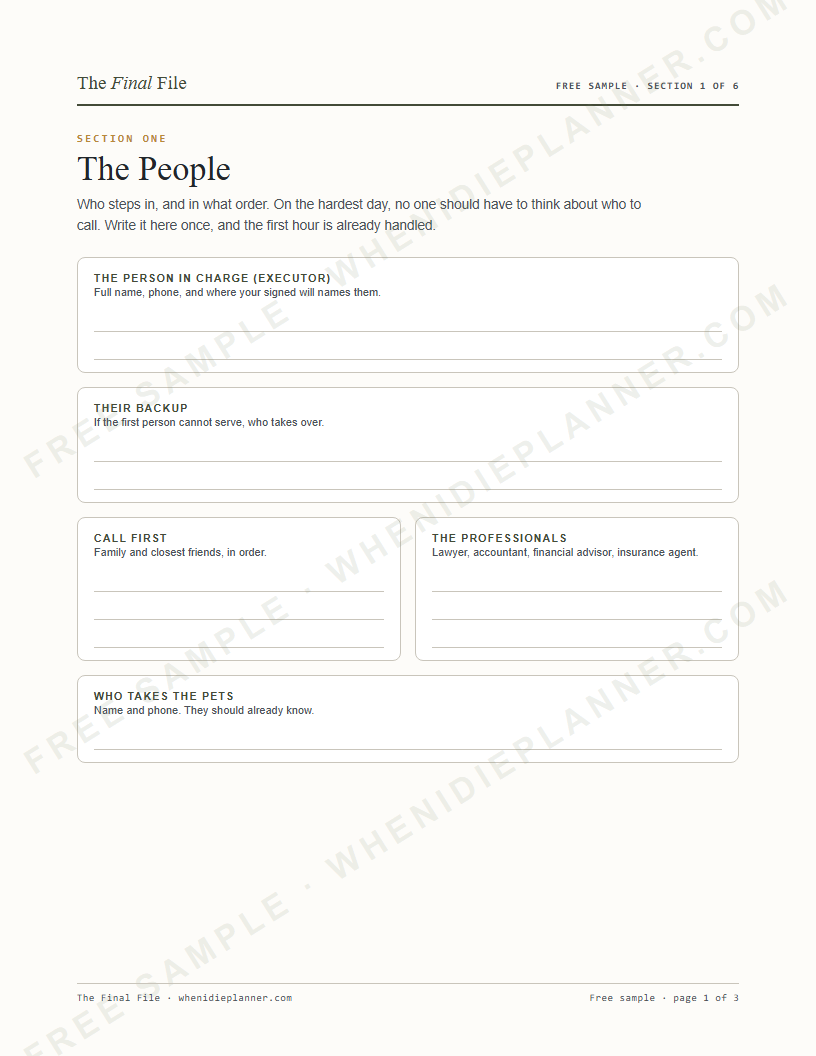
- 1. The people. Your executor and a backup, the family to call first, and the professionals: lawyer, accountant, advisor, insurance agent.
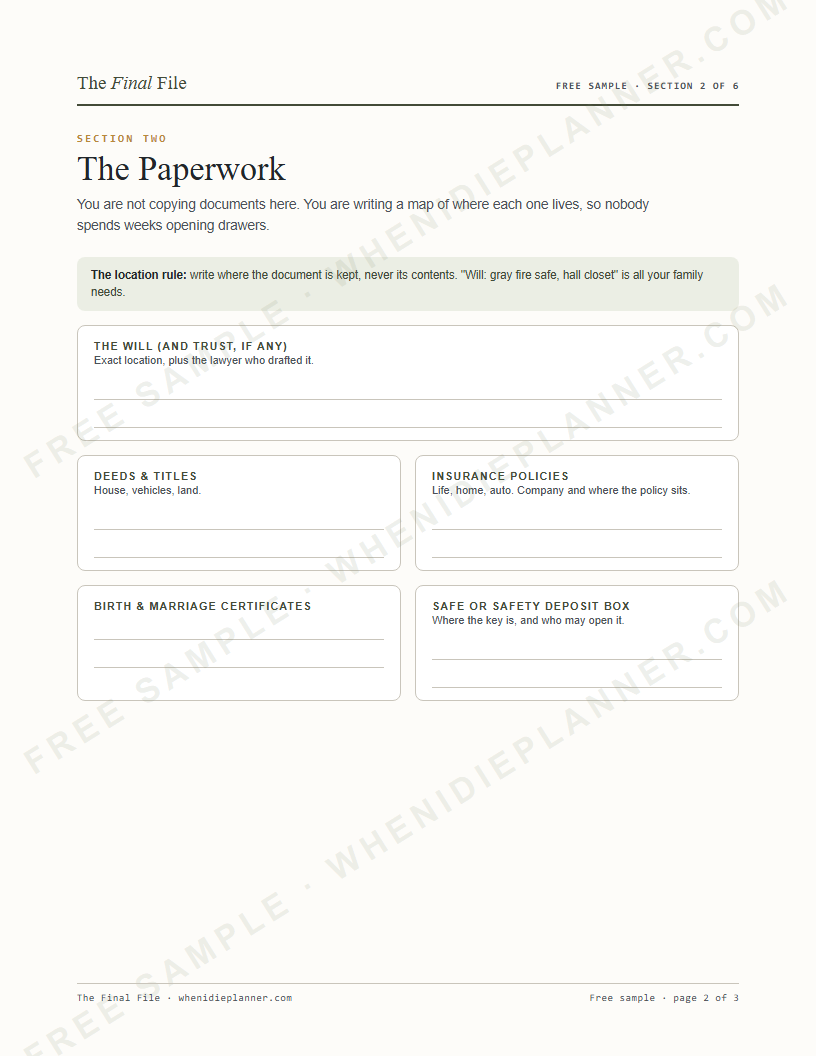
- 2. The paperwork. Where the will, trust, deeds, titles, insurance policies, and certificates physically live. Locations only, never contents.
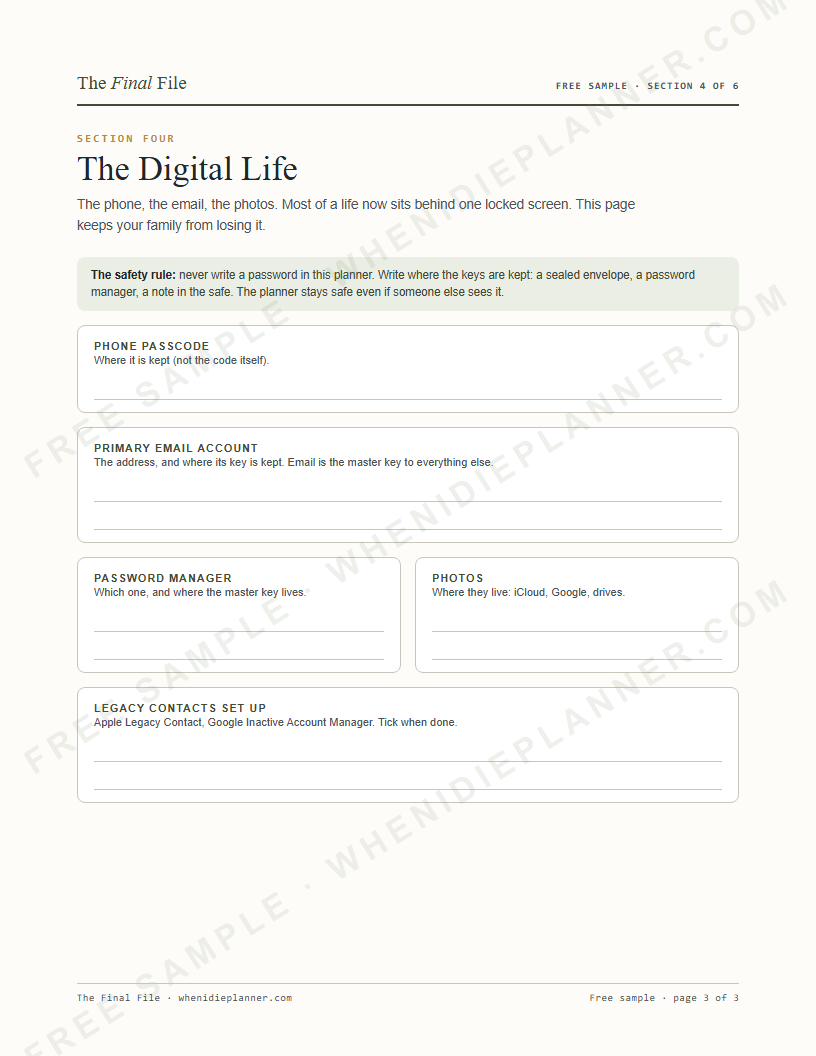
- 3. The digital life. The phone, the email, the photos, and where the keys to each are kept. Email deserves special care, because it is the master key that resets everything else.
- 4. The money. Every bank account, card, investment, pension, and debt, plus the auto-payments and subscriptions that need canceling.
- 5. The wishes. Medical preferences, burial or cremation, the service you want, and who takes the pets.
- 6. The personal. Letters to the people you love. The only section they will keep forever.
One rule keeps the whole thing safe: never write a password in your planner. Write where the keys are kept instead: a sealed envelope in the safe, a password manager, a note only your executor knows about. Done this way, the planner is useful to your family and useless to a stranger.
Try it free: three printable planner pages
These are three real pages from The Final File, watermarked, free to print and fill in. They cover the three questions every family asks first. Each one is in the free PDF download.
Choosing the best end-of-life planner: book, binder, PDF, or digital
Every format works if you finish it. They fail in different ways, so choose for the failure you are most likely to hit.
A printed end-of-life planner book feels substantial and lives on a shelf. The catch: when your bank changes or you move house, you are crossing things out in pen, and you cannot print a fresh page. Physical planners also cannot be delivered today; they arrive when the courier does.
A three-ring binder you build yourself is the most flexible and the least likely to get finished. Most self-built binders stall at the tab-label stage because designing the questions is the actual work. If you go this route, our step-by-step binder guide gives you the structure.
A fill-in PDF planner is the middle path and the one we make. It downloads instantly, prints at home on letter paper, goes into any binder or folder, and when something changes you print one fresh page instead of buying a new book. Paper stays private: no account, no cloud, nothing to hack.
A digital end-of-life planner or app is easy to update but asks your family to remember a login for the exact service that holds all the other logins, and asks you to trust a startup's servers with the map to your entire life. Some are excellent. Read their data policy before you type anything in.
Whichever you choose, you can see every page of ours filled in before deciding. We keep the samples public because a planner is not something you should buy on faith.
How to fill yours in over one afternoon
Block one afternoon. Start with the people, because naming your executor is the decision that unblocks everything else. Then walk the house once with the paperwork section and write down locations as you go. List the accounts from your last two bank statements, which catch nearly every auto-payment. Do the digital page with your phone in your hand. Write the wishes plainly. Save the letters for last, and take your time with them.
Then the step most people skip: tell one person the planner exists and where it lives. A planner nobody can find helps nobody. That one sentence to one person is the difference between a document and a gift.
The Final File
A complete fill-in-the-blank end-of-life planner. Six sections, one afternoon, instant download. Your passwords never leave your home.
Get the planner $29Common questions
Is an end-of-life planner a legal document?
No, and that is its strength. It is an organizer that sits alongside your will and tells your family where everything is, including the will itself. You do not need a lawyer to make one.
What age should you make one?
Any adult with a bank account, a phone, and people who would have to sort things out. Most buyers are between 50 and 75, but plenty of younger parents make one after their first child arrives.
How often should I update it?
Once a year, or after any big change: a move, a new account, a marriage, a divorce. With a printable planner you reprint one page rather than starting over.
Is there a free version?
Yes. Start with the free printable end-of-life planner pages: The People, The Paperwork, and The Digital Life, no email required.